

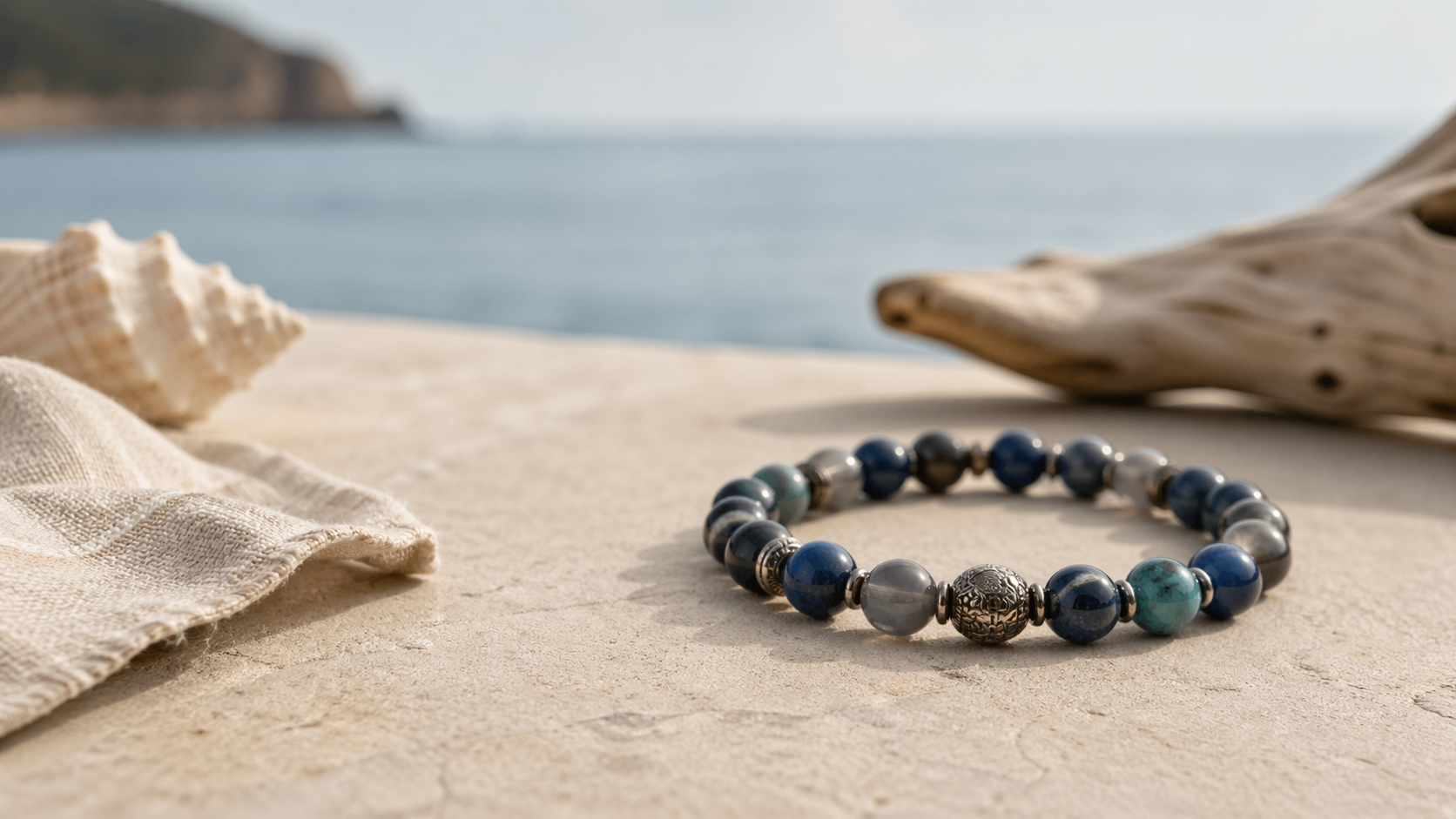
Identifying Real Gemstones: The Scientific Guide to Authenticity in Natural Stone Jewelry
In the world of modern jewelry design, a remarkable shift has occurred. While industrial mass-produced goods dominated the market for a long time, discerning buyers today are increasingly looking for the unadulterated, the given, the unique. Natural stone jewelry has become an expression of a personality that values permanence and aesthetic depth. However, with the rising demand for high-quality gemstone bracelets and necklaces, the challenge for consumers also grows: How can authenticity be determined beyond doubt in a digital market?
Identifying real gemstones is much more than a technical necessity; it is an homage to the geological history of our earth. Every natural stone is a product of millions of years of processes under extreme pressure and heat. This history leaves traces—characteristics that no machine or laboratory can perfectly imitate. Those who understand the language of stones not only protect themselves from bad purchases but also develop a deeper appreciation for the handcrafted unique pieces they wear.
The Ontology of Imitation: From Glass to Synthetic Crystals
Before identification methods can be discussed, a differentiated look at what is often falsely declared as natural stone in trade is necessary. The range extends from simple glass imitations to highly complex synthetic growths. Glass and plastics form the lowest level of imitations. They are often used to imitate the vibrant colors of stones like amethyst, turquoise, or ruby, but lack their density and hardness.
Particularly tricky are so-called doublets or triplets. These are composite stones where a thin layer of a real gemstone is glued onto a cheaper base material, such as glass or colorless quartz. In set jewelry, this glue line is often barely visible to the naked eye. Another field is synthetic stones grown in laboratories under controlled conditions. They are often chemically identical to their natural counterparts but exhibit a perfection that is almost impossible in nature. Paradoxically, this perfection is often the clearest sign of a non-natural origin.
The Physical Basis: Mohs Hardness as a Primary Distinguishing Feature
One of the most fundamental tools for determining minerals is the Mohs scale of mineral hardness. Developed in the early 19th century by Friedrich Mohs, this scale ranks minerals based on their scratch resistance. A mineral is considered harder than another if it can scratch the other without being damaged itself.
The relevance for the jewelry buyer lies in everyday durability. A stone with a Mohs hardness of over 7 is considered particularly durable, as it is resistant to the quartz dust contained in the air.
| Mineral / Material | Mohs Hardness | Practical Classification |
| Diamond | 10 |
The hardest known natural material. |
| Sapphire / Ruby | 9 |
Extremely resilient, ideal for daily use. |
| Amethyst / Rock Crystal | 7 |
Classic quartz varieties, scratches window glass. |
| Window Glass | 5.5 |
A common benchmark for imitations. |
| Turquoise | 5 - 6 |
Rather soft, requires careful care. |
| Copper Coin | 3 | Serves as a simple test for very soft imitations. |
A scientifically sound authenticity test can consist of carefully checking whether a stone can scratch a piece of glass. A real amethyst will do this effortlessly, while a glass or plastic imitation will either slip off or sustain scratches itself. However, it should be noted that this test can be destructive and should be applied to high-quality unique pieces only with extreme caution.
Thermal Conductivity: The "Coldness" of Nature
A fascinating physical characteristic of gemstones is their thermal conductivity. Natural stones are generally excellent heat conductors. When you touch a real gemstone—especially at sensitive spots like the lip or wrist—it initially feels significantly cooler than a piece of plastic or glass.
This is because the stone efficiently dissipates body heat, while plastics act as insulators and adapt almost instantly to skin temperature. A simple test for home is the "breath test": If you blow on a real gemstone, the film of moisture disappears almost instantly. On glass, however, the fog lingers significantly longer. This method is particularly helpful in distinguishing rock crystal from glass, as both can look very similar optically.
Visual Analysis and the Loupe as a Window to Truth
For the seasoned collector, the 10x jeweler’s loupe is the most important instrument. It allows a look into the interior of the stone and reveals its formation history.
Inclusions: The Fingerprints of the Earth
Contrary to popular belief, absolute purity is extremely rare in natural stones and is often an indication of a synthesis or a glass imitation. Real gemstones almost always contain inclusions—small mineral deposits, tiny cracks (healing fractures), or fluid bubbles that were trapped during crystal growth. These features are irregular and follow the laws of crystal geometry.
In contrast, if you find perfectly round air bubbles under the loupe, this is an unmistakable sign of glass. These are created during the melting process and do not occur in natural minerals. Similarly, "swirls" or flow structures reminiscent of stirred syrup are an indication of glass.
Color Treatment and Surface Structures
Many natural stones exhibit uneven color distribution, known as color zoning. In a real sodalite or tiger's eye, closer inspection reveals fine nuances and shades that appear organically grown. However, if a stone has an unnaturally uniform, garish color, or if the color is concentrated in the fine cracks on the surface, this points to chemical dyeing.
Howlite is particularly often dyed to imitate the more valuable turquoise. Real turquoise possesses a density and a matrix of fine rock veins that often look artificial or very superficial when dyed.
Optical Phenomena: Light as a Means of Identification
Some of the most beautiful natural stones in the AKROMI range are characterized by special optical effects that are physically difficult to imitate.
Chatoyancy and Silk Luster
Tiger's eye is the most prominent example of the chatoyancy effect (cat's eye effect). This occurs through the parallel embedding of fibers that reflect light in a narrow, shimmering band. When you rotate a real tiger's eye stone, this light band moves silkily across the surface. In plastic imitations, this effect often appears static or the fibers are recognizable as coarse structures.
Pleochroism: The Multifaceted Nature of Colors
Some gemstones show different colors or color saturations depending on the viewing angle. This phenomenon is called pleochroism and is caused by the direction-dependent absorption of light in the crystal lattice. A strongly pleochroic stone like tanzanite or certain tourmalines reveals a liveliness in motion that cannot be reproduced by glass imitations. Ruby also shows nuances from purplish-red to a more orange-red under different angles.
The Significance of the Setting and Used Metals
The authenticity of a piece of jewelry is not limited to the stone. High-quality natural stone jewelry is almost exclusively combined with precious metals like 925 Sterling Silver.
925 Sterling Silver vs. Fashion Jewelry Alloys
Real Sterling Silver consists of 92.5% pure silver and is marked by the "925" stamp. Silver is a relatively heavy metal and possesses specific thermal conductivity. An important test for the authenticity of silver is the magnet test: Silver is diamagnetic and is not attracted by a magnet. If a piece of jewelry reacts strongly to a magnet, it usually has an iron or nickel core that was only thinly silver-plated.
Natural oxidation—the so-called tarnishing of silver—is, contrary to many prejudices, a quality feature. It proves the reaction of the real precious metal with hydrogen sulfide in the surrounding air. This patina can be easily removed from real silver, while in low-quality fashion jewelry, the coating often permanently flakes off.
Gold Vermeil and Durability
For aesthetic "Modern Classics," Gold Vermeil is often used. This is a high-quality gold plating on a base of Sterling Silver. In contrast to simple PVD coating on stainless steel, Vermeil offers a higher value and a color depth very close to solid gold. Buyers should pay attention to the layer thickness here to ensure the longevity of the aesthetic appearance.
Specific Gravity: The Weight of Truth
Specific gravity (density relative to water) is one of the most reliable constants in mineralogy. Every gemstone has a characteristic density. A sapphire, for example, is almost twice as dense as an opal of the same size.
In practice, this means a real natural stone should feel "substantial" in the hand. It possesses a certain weight that plastic imitations, which are significantly lighter for the same size, lack. If a large gemstone bracelet feels surprisingly light like a toy, extreme skepticism is warranted.
Expert Knowledge and Transparency: The Key to a Safe Purchase
Despite all home tests, professional appraisal by a gemologist or a certified laboratory remains the safest method, especially for high-priced unique pieces. A serious online shop distinguishes itself by providing detailed information about the origin and treatment of the stones.
Certifications and Documentation
An independent gemstone certificate objectively describes features such as cut, carat weight, color, and clarity. It also documents possible treatments like the heating of sapphires for color improvement—a common industry practice that must, however, be communicated transparently. At AKROMI, this claim is underlined by the careful selection of materials and the focus on handcrafted unique pieces.
The Role of the Seller
Ask specific questions: Where does the stone come from? Is it stabilized or dyed? What metallic alloys were used? An expert will be able to answer these questions precisely. In an era of "Conscious Gifting" and mindful consumption, this knowledge is the actual luxury.
Conclusion: The Aesthetics of Authenticity
Real natural stones are much more than decorative elements. They are fragments of earth's history, telling a story of time, pressure, and natural completion. The ability to recognize this authenticity not only protects the material value of an investment but also deepens the emotional connection to the piece of jewelry.
The physical properties—from the unmistakable Mohs hardness to the thermal coolness and the individual inclusions—make every stone a unique specimen. Those who learn to read these features will be able to re-evaluate the quality of AKROMI unique pieces and Modern Classics. It is the combination of scientific clarity and aesthetic excellence that makes high-quality jewelry a lifelong companion.
Discover the variety of real natural stones in our collections. Every piece is a promise of quality and authenticity, handcrafted for people seeking the extraordinary in the true. From the deep blue nuances of [Lapis Lazuli] to the shimmering—find your personal stone that not only underlines your style but also meets your high standards for genuine craftsmanship.